Tomar and the Convent of Christ: a day trip from Pombal (40 km, 49 minutes)
Yes, and it is the easiest UNESCO day trip on our list. From Abiul the Convent of Christ is 40 km and about 49 minutes away, almost entirely on country roads — no motorway, no tolls. The ticket is €15 and the monument opens every day, 09:00–17:30 from October to May (last entry 17:00). Plan on two to three hours inside and another two in Tomar's old town: leave the house at 09:15 in November and you are back for a late lunch by the pool.
Why this one, and not another monastery
Central Portugal has more UNESCO monuments per hour of driving than almost anywhere in Europe, and we are spoiled by it: Alcobaça at 35 minutes, Batalha at 30. Tomar is different in kind. Alcobaça and Batalha are masterpieces you look at. The Convent of Christ is a building you walk through for seven centuries in a single loop — a 12th-century Templar rotunda, a Manueline nave, five Renaissance cloisters and a 17th-century aqueduct that arrives over the roof.
UNESCO inscribed it in 1983 on criteria (i) and (vi): the primitive Templar church and its later additions form, in the committee's words, “a masterpiece of human creative genius”, and the complex began as a symbol of the Reconquest before turning into the opposite — the Manueline symbol of Portugal opening to other civilisations. That second reading is the one you feel standing in the Chapter Window.
The drive: 49 minutes, no tolls, no motorway
The route runs south-east from Abiul on the EM 501 through the hills, then picks up the EM 525 and the EN 113 into Tomar, finishing on the Estrada do Convento that climbs to the monument gate. It is 40 km of olive groves, stone walls and small villages — the kind of drive that makes people understand why we live here. Because there is no motorway, there is no toll transponder to worry about and no service-area coffee.
Two practical notes. First, the last kilometre is uphill and narrow; go past the first informal parking you see and follow the signs to the monument. Second, coaches tend to land mid-morning, so the 09:00 opening is worth the early alarm — the Charola with twelve people in it instead of eighty is a different building.
Seven centuries, in the order they were built
Tomar was founded by the Templars in 1160, and the castle that still crowns the hill was built with it. When the order was suppressed in 1312, the Portuguese crown simply reinvented it as the Order of Christ and kept the site. Under the administration of Infante D. Henrique between 1420 and 1460, the conventual rooms grew around two Gothic cloisters, the Claustro da Lavagem and the Claustro do Cemitério.
The heart of it all is the Charola, a rare medieval round church modelled on the paleo-Christian basilica of the Holy Sepulchre in Jerusalem. Its original entrance faced east until the works of D. Manuel I opened a new one to the south, in the nave that extended the oratory westwards. That Manueline nave was built by Diogo de Arruda between 1510 and 1513 and finished by João de Castilho between 1513 and 1515, and above the sacristy — the Sala do Capítulo — sits the Janela do Capítulo, the carved window that became the emblem of Portugal's maritime expansion.
From 1528, D. João III built the vast Renaissance convent that wraps west of the church around five cloisters. Under the Spanish kings, between 1580 and 1640, the Claustro Principal was finished, the Sacristia Nova was added in the Claustro do Cemitério, and the south facade was remodelled by the arcade of the Aqueduto dos Pegões — the most striking construction of the Philippine period. The last big works came in the final quarter of the 17th century: the great infirmary and the new pharmacy, which give the north flank the bulk you see from the approach road. In 1835 the politician Costa Cabral bought the convent grounds at auction; only in the mid-1980s did the State take full possession of the whole complex again.
What to see, in the order that works
- Charola first. Walk straight into the round church before anything else; it is the oldest thing here and the one room people remember.
- The Manueline nave and the Chapter Window. Climb to the Sala do Capítulo and give the window ten minutes — rope, coral, artichokes and armillary spheres carved in limestone.
- The João III cloisters. Five of them, in sequence, each with a different proportion; the Claustro Principal is the largest and the quietest.
- The aqueduct. Look up at the Pegões arcade from the terrace side; it is the reason the south facade reads like a stage set.
- The Mata dos Sete Montes. The old convent enclosure is now a wooded park on the hillside — a 30-minute walk if the weather is kind, and free.
Hours, closures and the ticket
One of the underrated things about the Convent of Christ is that it opens seven days a week — unusual for Portuguese monuments, many of which close on Mondays. The schedule, as published by Museus e Monumentos de Portugal, is October to May: 09:00–17:30, last entry 17:00; and June to September: 09:00–18:30, last entry 18:00. The normal ticket is €15 and can be bought online. It closes on 1 January, 1 March, Easter Sunday, 1 May, and 24–25 December.
What is closed right now
Conservation and restoration work funded through Portugal's PRR recovery plan is still running, and the monument is honest about it: access is currently restricted to the South Terrace and the path to the Horta dos Frades, the “da Cera” terrace of the Claustro Principal, the Claustro da Lavagem, and the garden and Terreiro. In plain terms: one Gothic cloister and the outdoor terraces are out of bounds, while the Charola, the Manueline nave, the Chapter Window and the main Renaissance cloisters — the reason you came — are all open. If a particular room is the whole point of your visit, ring ahead on +351 249 313 481.
After the convent: Tomar on foot
Walk down rather than drive. The Estrada do Convento drops you into the old town in fifteen minutes, past the Mata dos Sete Montes on your right. The grid of streets between the hill and the river Nabão is small enough to cross in twenty minutes and old enough to reward a slow hour: this was a Templar town, and it still feels like one. Eat late, Portuguese-style, and skip the places with photographs of the food.
A realistic November timetable: leave Abiul at 09:15, at the gate for 10:05, three hours in the monument, lunch in town at 13:30, coffee and a wander until 15:30, home by 16:30 with daylight to spare. In July and August, invert it — the cloisters are cool at opening, and the town is unbearable at three in the afternoon.
Where to base it
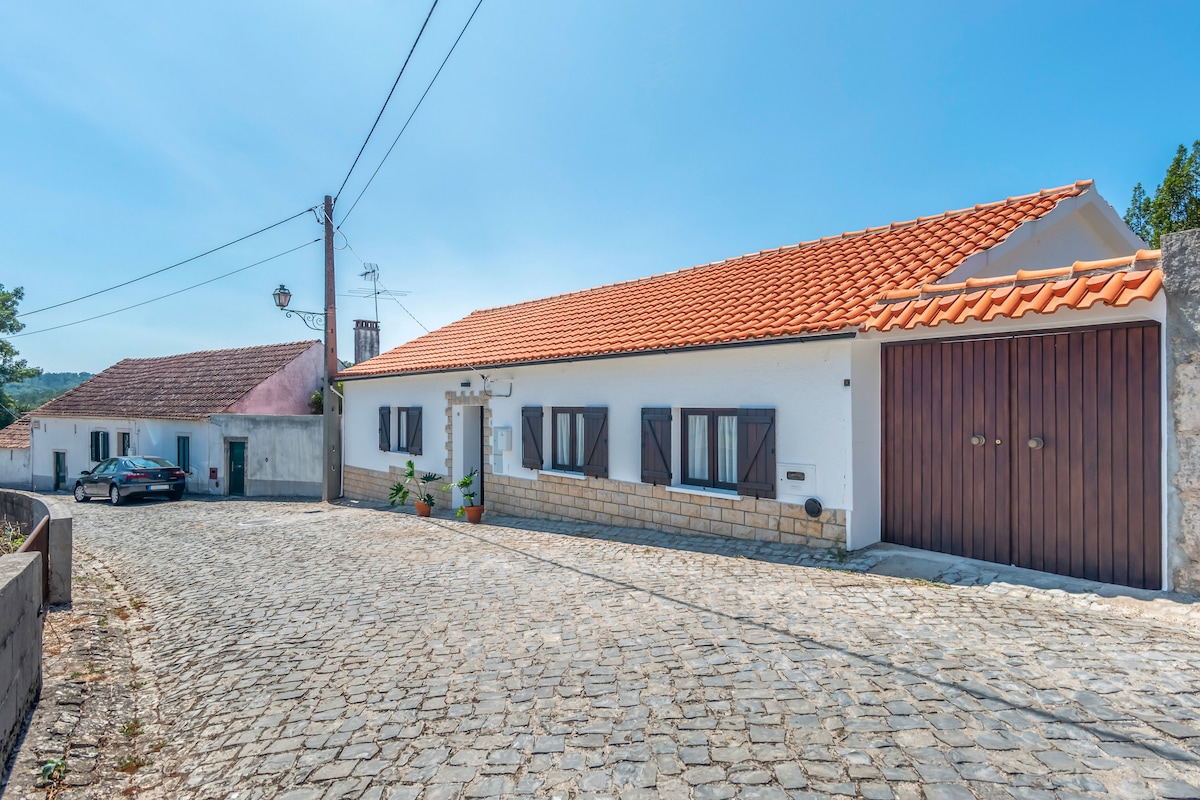
The whole point of staying in Abiul rather than in Tomar is that Tomar becomes a morning, not a hotel booking. Casa dos Duques is 11 minutes from Pombal and a few minutes from the A1, which puts four UNESCO sites inside an hour — our day trips page lists every one of them with real drive times. If you are planning a week of this, the Central Portugal guide explains how the region fits together, and the Pombal guide covers the castle and the old town ten minutes from the house.
One last thing worth saying: Tomar is not a box to tick on the way to Lisbon. The building rewards an unhurried morning, and the drive there is half the pleasure.
Sources: Museus e Monumentos de Portugal — Convento de Cristo (opening hours Oct–May and Jun–Sep, last-entry times, annual closures, €15 normal ticket, PRR restoration restrictions, history of the complex); UNESCO World Heritage List no. 265 (inscription 1983, criteria (i) and (vi), statement of Outstanding Universal Value). Distance and drive time calculated with OSRM from Abiul (39.8726, -8.5386) to the monument (39.6039, -8.4176): 40.2 km, 49 min. They are estimates, not guarantees — opening times, prices and closures change, so confirm with the monument before travelling.